


Mahjong Winning Hands: Illustrated Examples and Common Patterns
See how mahjong winning hands differ between American and Chinese versions, with beginner-friendly group examples, tile counts, and illustrated practice.

A clear beginner’s guide to recognizing complete mahjong hands, reading American card patterns, and avoiding mistakes that make a promising rack invalid.
Quick Answer: Mahjong winning hands depend on which version you play. In many Chinese-style games, a standard hand contains four sets and one pair, although special hands and scoring requirements create exceptions. In American mahjong, you must assemble exactly one 14-tile pattern printed on the current National Mah Jongg League card. Learning pairs, pungs, kongs, runs, and joker restrictions helps you recognize what can actually win.
ON THIS PAGE
Introduction • First, Identify Which Mahjong Rules You Are Playing
The Building Blocks: Pair, Pung, Kong, Chow, and Quint • A Standard Chinese-Style Hand: Four Sets and a Pair
How Mahjong Winning Hands Work in American Mahjong • Four Practice Patterns to Recognize Without Copying the Card
A Five-Step Checklist Before Calling Mahjong • Common Mistakes That Make an Almost-Winning Hand Invalid
How to Practice Winning Hands Without Memorizing Dozens of Rules • Frequently Asked Questions
Conclusion • Sources and Further Reading
Introduction
A row of matching tiles looks convincing until somebody at the table asks a deceptively simple question: “Is that a winning hand?” The answer depends on the rules on that particular table. A neat-looking run may be useful in Hong Kong-style mahjong but irrelevant to the American card. A joker that completes an American pung cannot stand in for a pair. And an apparently complete Chinese-style hand may still fail the table’s minimum scoring requirement.
This guide separates American mahjong from common Chinese-style hand structures instead of merging them into one invented universal rulebook. You’ll learn to read the building blocks, walk through an illustrative 14-tile Chinese-style example, understand what the American card requires, and spot common errors before announcing a win. The diagrams accompanying this article should be treated as instructional schematics, not reproductions of any copyrighted annual card.
First, Identify Which Mahjong Rules You Are Playing
“Mahjong” is a family of related games. American mahjong, typically played using a National Mah Jongg League (NMJL) card, has a published set of permitted hand patterns that changes each year. You cannot simply collect any attractive combination and declare mahjong. The whole rack must match one line of that year’s card, respecting suits, numbers, flowers, exposure restrictions, and joker rules.
In many Chinese variants, a familiar basic structure is four sets plus a pair. A set may be a sequence of suited tiles or a group of identical tiles, depending on the version. However, local variants can recognize special hands, require a minimum scoring value, or use different scoring and calling conventions. Hong Kong-style play, Chinese Official/Mahjong Competition Rules, and other regional systems are not identical.
If you learn with friends, ask two questions before you study winning hands: “Which version are we playing?” and “What rulebook, card, or house rules decide a win?” Those answers save more frustration than memorizing dozens of sample arrangements.
The Building Blocks: Pair, Pung, Kong, Chow, and Quint
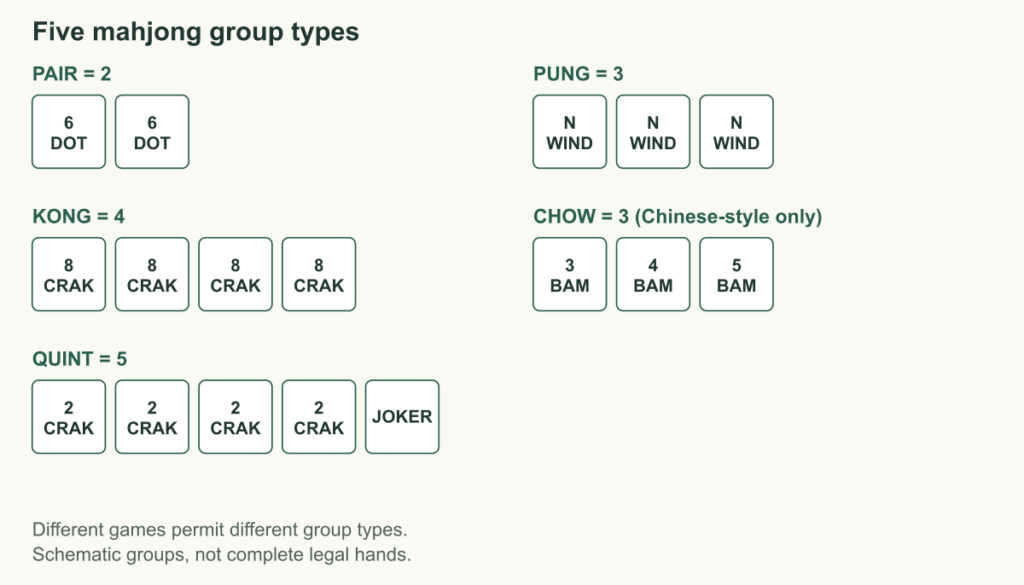
Begin by recognizing the small groups. These are useful vocabulary terms even when their role differs by ruleset.
| Group | Tile structure | Common use or warning |
|---|---|---|
| Pair | Two identical tiles | Often a finishing component; American jokers cannot make a pair |
| Pung | Three identical tiles | Used in many variants; American jokers can be used subject to the card and rules |
| Kong | Four identical tiles | Exists in several variants but replacement-draw rules differ |
| Chow | Three consecutive numbers in one suit | Common in many Chinese variants; not a building block for NMJL card hands |
| Quint | Five matching tiles, usually using a joker | Appears in specific American card patterns, not an everyday Chinese set |
A useful practice exercise is to place tiles into visible groups on a table. Make a pair of 6 Dots, a pung of North Winds, and a chow of 3-4-5 Bams. Say each group’s name aloud, then check whether your chosen version permits the group in the way you plan to use it.
Important distinction: Understanding a legal-looking group is not the same as assembling a legal winning hand. In American play the current card decides which groups belong together; in Chinese play the complete hand and any scoring requirements decide whether a declaration is valid.
A Standard Chinese-Style Hand: Four Sets and a Pair
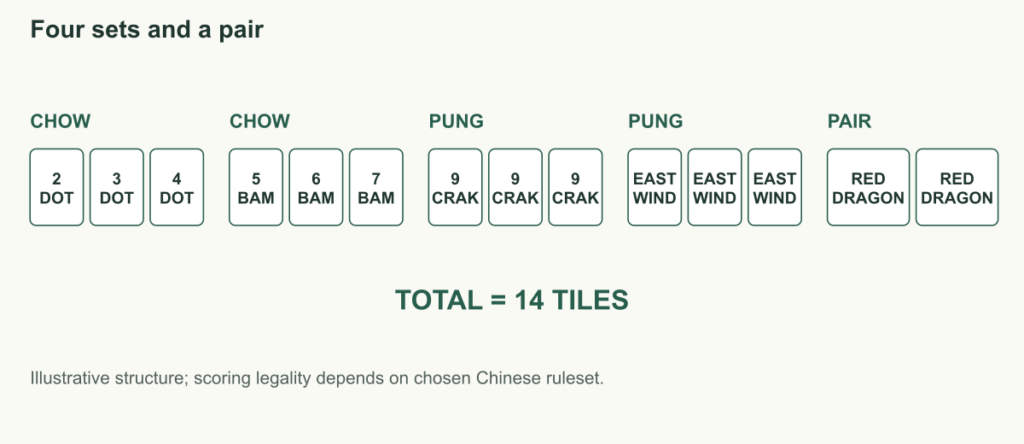
Here’s an illustrative 14-tile arrangement using the basic four-sets-and-a-pair structure. It is a teaching example of the shape, not a promise that it satisfies every regional scoring minimum.
| Component | Example tiles | Number of tiles |
|---|---|---|
| Chow 1 | 2 Dot, 3 Dot, 4 Dot | 3 |
| Chow 2 | 5 Bam, 6 Bam, 7 Bam | 3 |
| Pung 1 | 9 Crak, 9 Crak, 9 Crak | 3 |
| Pung 2 | East Wind, East Wind, East Wind | 3 |
| Pair | Red Dragon, Red Dragon | 2 |
| Total | Four sets plus a pair | 14 |
Notice that both chows remain within one suit. “2 Dot, 3 Bam, 4 Crak” is not a chow simply because the numbers are consecutive. Also notice that the pair is not a third tile group: it contains exactly two identical tiles.
The illustration separates five groups and counts exactly 14 tiles. In a real game, also verify how the hand was drawn, whether groups may be claimed or must remain concealed, the winning tile, and any minimum score or pattern restrictions under your group’s rules.
What if you have a kong?
Kongs represent four identical tiles and trigger additional procedures in many Chinese games, including a replacement draw. That’s why casually adding a fourth tile to the 14-tile teaching example and still calling it a complete hand creates confusion. Learn the kong procedure from your chosen rulebook before treating a four-of-a-kind as an ordinary three-tile set.
Are there special hands outside the basic pattern?
Yes. Depending on the variant, recognized special hands may include seven pairs, thirteen orphans, or other named patterns. They come with variant-specific restrictions and scoring. Do not infer that every special hand is legal in every Chinese-style game, and never transfer those patterns directly onto the American NMJL card.
How Mahjong Winning Hands Work in American Mahjong
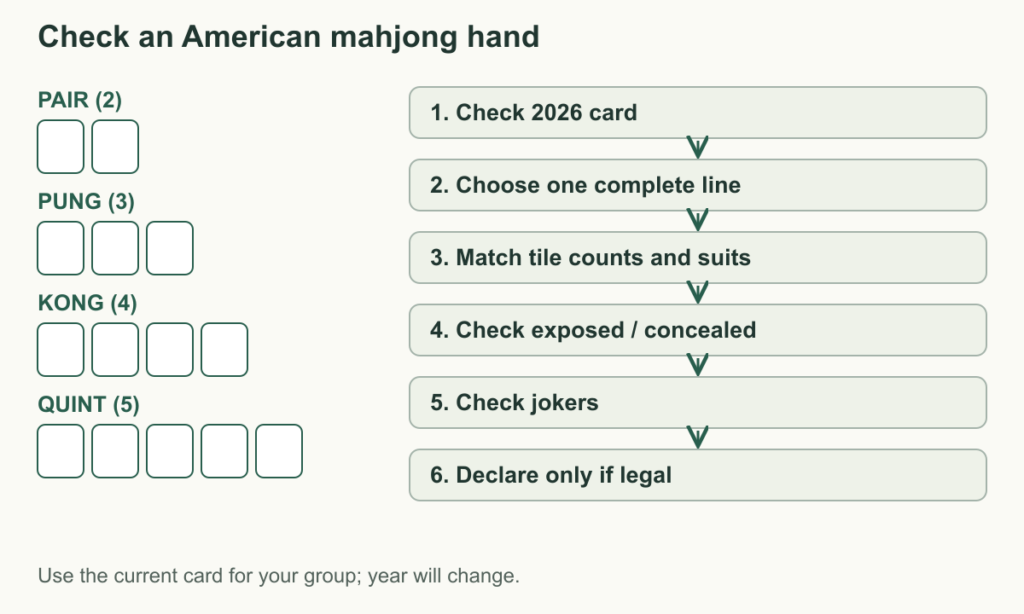
American mahjong changes the question from “Do I have four sets and a pair?” to “Does my rack match one complete line of the current year’s card?” The National Mah Jongg League sells a new card each year, and the card controls legitimate winning patterns. For groups playing the 2026 edition, use the 2026 card; when a new card becomes current for your group, use that edition instead.
Each line specifies numbers, suits or suit relationships, and the sizes of groups needed for a complete hand. Some lines allow exposed play; others are marked concealed. Tiles representing the year, flowers, winds, and dragons may appear, but their legal arrangement must be read from the card rather than guessed from another year.
For a quick mental model, look at four building blocks: pair = 2 identical tiles, pung = 3, kong = 4, quint = 5. Those fragments help you decode a line, but combining any four fragments into fourteen tiles does not automatically create a winning hand. Only a full line on the card can do that.
The joker rule beginners most often miss
Under standard NMJL-style American play, jokers can help complete eligible groups of three or more identical tiles, subject to the usual rules for calls and exposures. They cannot represent a single tile or one of the two tiles in a pair. A perfect-looking hand with a joker inside a required pair is therefore not valid under those rules.
A concealed line also deserves special care: an exposure that was legal for one pattern may rule out a switch to a concealed pattern. When in doubt, consult the current card and the group’s official instructions before declaring mahjong or exposing a group.
Four Practice Patterns to Recognize Without Copying the Card
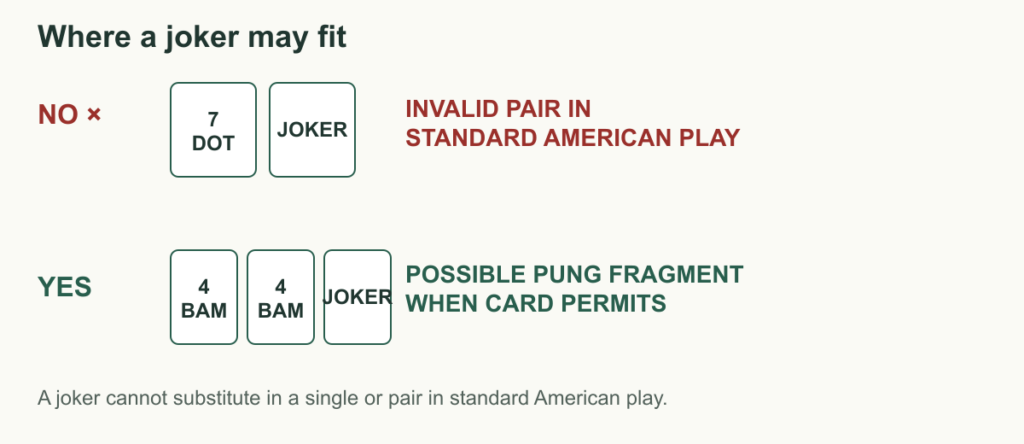
These are mini-exercises, not complete American winning hands. They’re designed to make the group terminology recognizable on sight.
Practice pattern A — Two matching tiles. Lay out two 7 Dots. That’s a pair. Now replace one with a joker and ask whether it remains valid in standard American play. It doesn’t: pairs need the actual matching tiles.
Practice pattern B — A three-tile group. Lay out three 4 Bams. That’s a pung. Replace one with a joker to illustrate a type of substitution that can be permitted in a qualifying American group, provided the complete card line and exposure rules allow it.
Practice pattern C — A four-tile group. Lay out four North Winds. That’s a kong as a group name. Count carefully: a pung and a kong do not use the same number of tiles, even if both feature matching symbols.
Practice pattern D — A five-tile group. Lay out four 2 Craks and one explicitly labeled joker. This illustrates why American quints rely on joker substitution for ordinary number tiles: a standard set has only four natural copies of each such tile. It is still not a complete winning hand by itself.
The illustration contrasts a prohibited joker pair with a possible pung fragment. Count every tile carefully and check the full card line before treating a promising group as part of a winning hand.
A Five-Step Checklist Before Calling Mahjong
1. Name your ruleset. Is the table using the current NMJL card, a specific Hong Kong ruleset, Chinese Official rules, or another agreement? If you cannot answer, do not assume your hand is complete.
2. Count the tiles. Check group sizes and the total according to your version. For a simple 14-tile teaching example, confirm four three-tile sets and a pair; account correctly for kongs and replacement procedures in the actual game.
3. Check suits and sequences. Suited chows must belong to one suit in variants that use them. American card colors express suit relationships, so read them against the card’s legend.
4. Confirm jokers and exposures. For American play, verify that jokers do not occupy singles or pairs. Confirm whether the target hand is allowed to be exposed and whether any claimed discard follows the rules.
5. Confirm the complete winning condition. In American mahjong, match the entire card line; in your Chinese-style game, confirm any minimum scoring requirement, hand restrictions, and winning declaration conditions.
An experienced player can make this process look instantaneous. Beginners benefit from checking the criteria aloud, even if that briefly interrupts the flow of the game.
Common Mistakes That Make an Almost-Winning Hand Invalid
Mixing versions halfway through. A reference image online might show a Chinese chow while your local group plays American mahjong. The image can be accurate for its own version but misleading for yours. Always read the ruleset label before saving a cheat sheet.
Treating a pair like a replaceable group. A joker in an American pair is a classic error. The convenient tile substitute doesn’t override the card’s restrictions.
Counting sets but missing the complete pattern. A rack may contain multiple beautiful pungs and still not match any card line. In the American game, the card is the authority, not the visual neatness of the rack.
Overlooking a concealed requirement. When a hand must remain concealed, an unnecessary exposure can close off that path. Practice reading the disclosure or concealment notes before you call a discard.
Assuming every traditional pattern automatically scores enough. The basic four-sets-plus-pair shape is useful, but some Chinese variants impose a minimum score or recognize special conditions. Double-check rather than turning the beginner shortcut into an absolute rule.
Using a diagram with inaccurate tiles. A swapped suit, a fifth natural 9 Dot, or a fabricated annual card line may look polished and still be wrong. Count the symbols and compare them with the written explanation every time.
How to Practice Winning Hands Without Memorizing Dozens of Rules
Start with ten minutes of grouping practice. Take a handful of tiles and sort them into suits, winds, dragons, and flowers. Make pairs and pungs, then practice identifying a chow with three consecutive numbers in one suit. This exercise teaches vocabulary without requiring a full table.
Next, choose one version. If you’re learning American mahjong, obtain the current league card and identify three card lines that look approachable. Compare the group sizes and count all fourteen tiles. Do not reproduce the card in a public study handout; use the official card alongside your own blank diagram.
If you’re learning a Chinese-style game, build and inspect a basic four-sets-and-a-pair arrangement and then read what would be necessary to claim and score it in the specific local ruleset. Finally, play a short practice game where the goal is to recognize why a declaration is valid or invalid rather than to play quickly.
Frequently Asked Questions
What is the easiest mahjong winning hand for beginners?
There is no universal easiest hand. In a Chinese-style game, the standard sets-and-pair structure is a useful starting point. In American mahjong, choose an approachable pattern from the current annual card based on the tiles you are dealt.
Can four sets and a pair win in American mahjong?
Not by themselves. An American winning hand must match an entire pattern on the current NMJL card, including all its tile, suit, and exposure requirements.
Can a joker be used in a mahjong pair?
Not under standard NMJL-style American rules. Jokers cannot substitute for singles or pairs, although they can be used in eligible matching groups of three or more.
Are seven pairs a legal mahjong hand?
Some non-American variants recognize seven pairs as a special hand, but availability and scoring vary. The basic rule is to consult the actual variant’s hand list rather than assume it is universal.
Do I need a new American mahjong card every year?
For current NMJL-style play, yes: the card changes annually. Use the edition your group has agreed to play and obtain it from the official league rather than relying on an old screenshot.
Conclusion
Mahjong winning hands become less mysterious once you stop treating every version as one game. Learn the basic tile groups, practice a clear Chinese-style sets-and-pair example, and let the current card determine American wins. The real skill is not memorizing one magical arrangement; it’s checking whether your full rack satisfies the rules at your table. Start with accurate diagrams, a named ruleset, and a little patient practice.