


How to Play Mahjong With 2 Players: Rules, Setup, and Examples
An accurate introductory guide to a named two-player American mahjong format, including two-rack setup, the 27-tile deal, turn flow, and rule variations.

You don’t need four friends around a table to enjoy mahjong. Two-player adaptations make it possible to practice with one other person—but the rules are not identical to a standard four-player game. Here is a clear way to get started without mixing different versions.
Introduction
You have a mahjong set, a friend who wants to learn, and only two chairs at the table. Can you still play? Absolutely. The catch is that “two-player mahjong” describes several adaptations, not one universal rulebook. Some simplify the game into a draw-and-discard exercise. Others ask each person to work on two full winning hands at once.
This guide concentrates on the Siamese Mah Jongg® approach associated with Gladys Grad, an established American-style two-player format. It uses two racks per person, two simultaneous hands, and an American mahjong card. We describe the main rhythm and refer to its published rules for details that are easy to overlook. We also explain a popular informal variation so you know why two tutorials might give different instructions.
Quick Answer: To play an established Siamese-style two-player American mahjong game, each person uses two racks and works toward two valid 14-tile hands. Under the published Gladys Grad rules, players build walls, start with 27 tiles each, skip the Charleston, and East draws a 28th tile before the opening discard. The game ends when one player completes two valid mahjongs or the playable tiles run out; follow the full named ruleset for scoring and claims.
ON THIS PAGE
Introduction • First, Decide Which Two-Player Mahjong Rules You Mean
What You Need to Play Mahjong With Two People • Step-by-Step Setup for the Published Siamese Game
A Simple Example of the Turn Sequence • Three Rules That Commonly Confuse Beginners
An Easy Practice Session for Your First Evening • How Two-Player American Mahjong Differs From Four-Player Play
Frequently Asked Questions • Conclusion
First, Decide Which Two-Player Mahjong Rules You Mean
The phrase “Siamese mahjong” is often used loosely, but rule variations matter. The published Gladys Grad Siamese Mah Jongg rules require walls in tournament play and describe an initial 27-tile deal to each person, with East drawing to begin. A short Southern Sparrow tutorial describes a casual no-walls format with 27 and 28 tiles immediately assigned. Missy Mahjong teaches a separately named “One on One Mahj” adaptation.
None of these should be silently blended. For this walkthrough, use the published Gladys Grad rules as the governing reference. If your group prefers an informal version, agree on its deal, wall, claiming, and scoring rules before starting. This matters especially if one person learned from a video while the other read an official rule sheet.
| Question | Published Gladys Grad rules used here | Casual variations may… |
|---|---|---|
| Racks per player | Two | Also use two |
| Walls | Built; required for tournament play | Use a face-down tile pool |
| Initial deal | 27 tiles per player; East then draws | Assign 27 and 28 initially |
| Charleston | None | Usually omit it |
| Objective | Two valid mahjong hands | Keep two hands but vary declaring/scoring |
What You Need to Play Mahjong With Two People
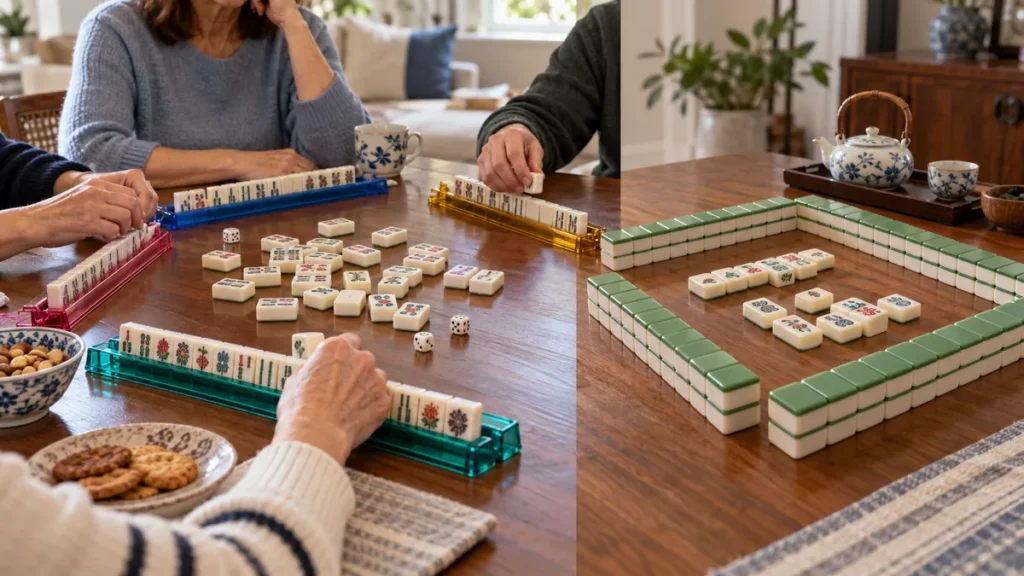
Start with an appropriate American mahjong tile set (commonly 152 tiles), four individual racks or two double-rack setups, a die for the published wall-breaking procedure, and a mutually agreed current American hand card. A flat surface with room for the walls, both players’ racks, and a visible discard area will make the game easier to follow. If you use the published Siamese rules, check the full instructions for the precise wall break and deal.
A printed hand card or official digital reference is important because American winning patterns are defined by a card rather than by any arbitrary arrangement of fourteen tiles. The rules permit use of NMJL or recognized Siamese cards according to the agreed game; be consistent about which card is in force. Don’t reproduce the card from an AI image or improvise example winning patterns.
A small notebook can help track questions between rounds. It is less helpful to stop a live hand every minute to search the internet for advice that may belong to a different ruleset.
Step-by-Step Setup for the Published Siamese Game
Step 1: Place two racks in front of each player
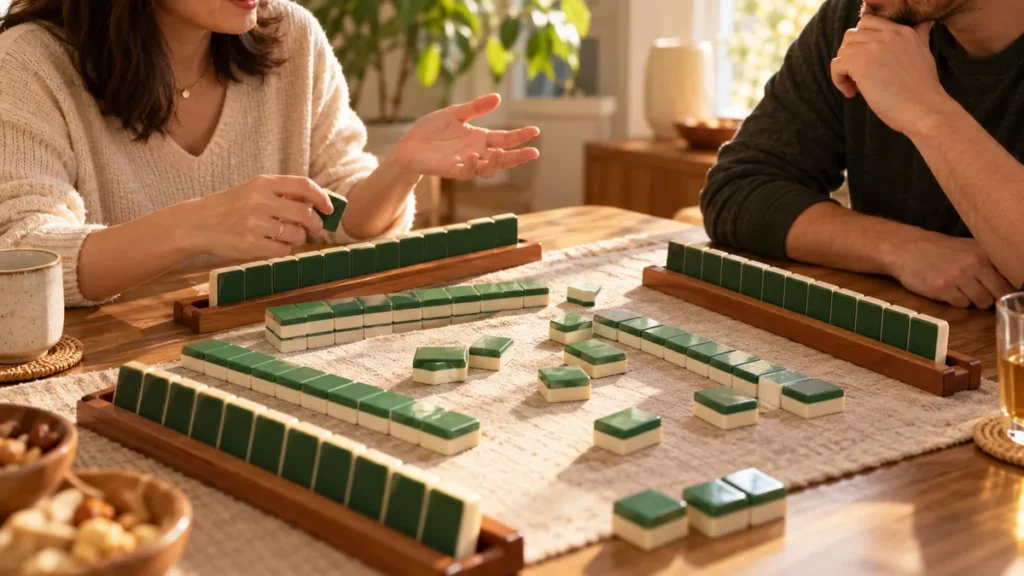
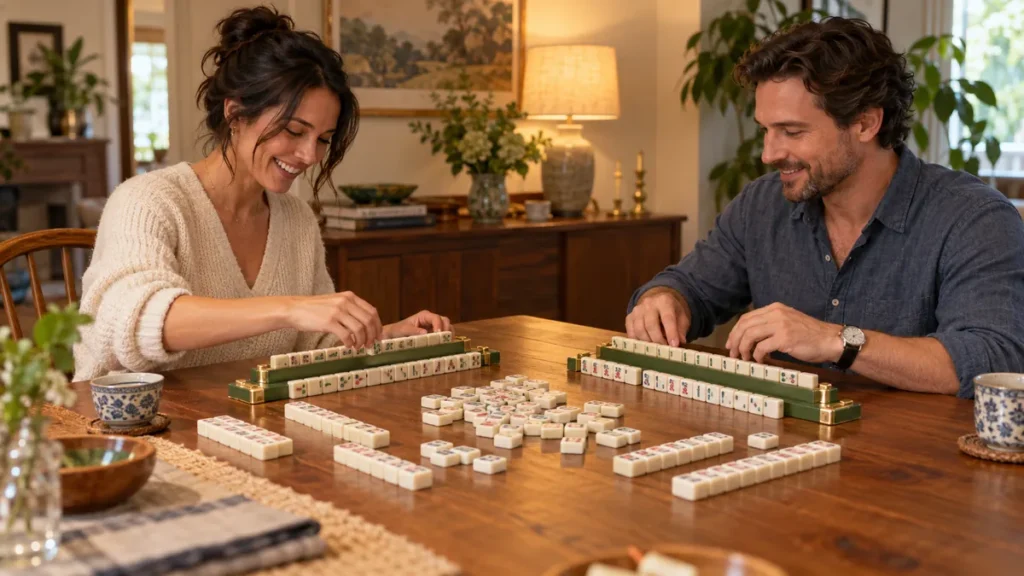
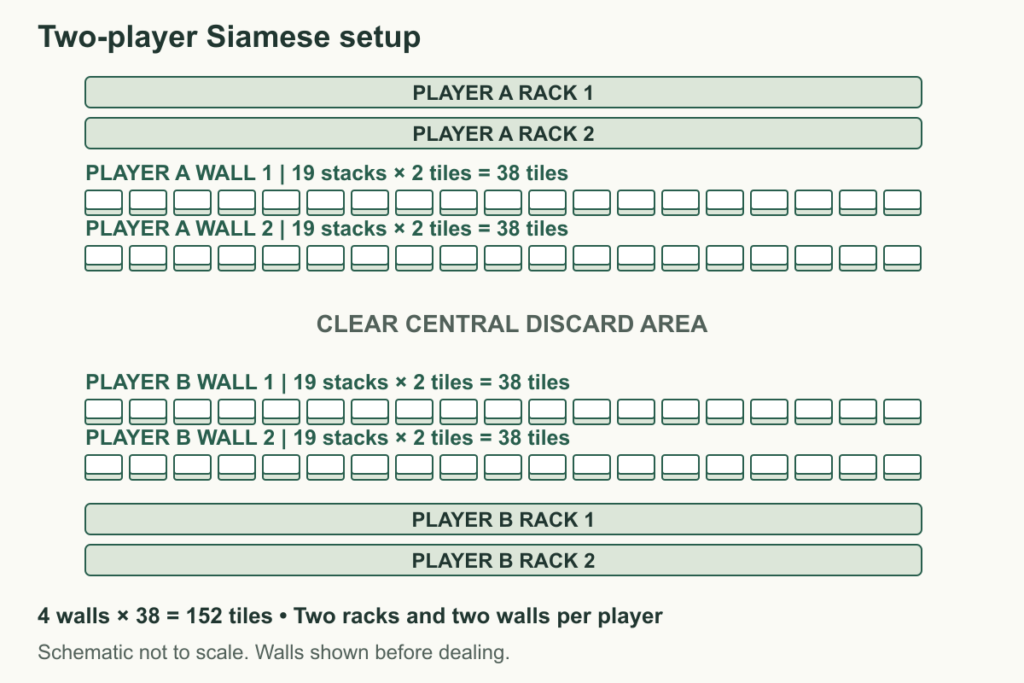
Sit opposite your partner. Each player uses two racks, or one purpose-made double rack, to develop two hands. Think of the racks as separate potential winning hands whose unexposed tiles you can manage together under the variant’s rules. Keep the flat exposure ledges clearly associated with the correct rack.
Step 2: Build the walls and make the opening deal
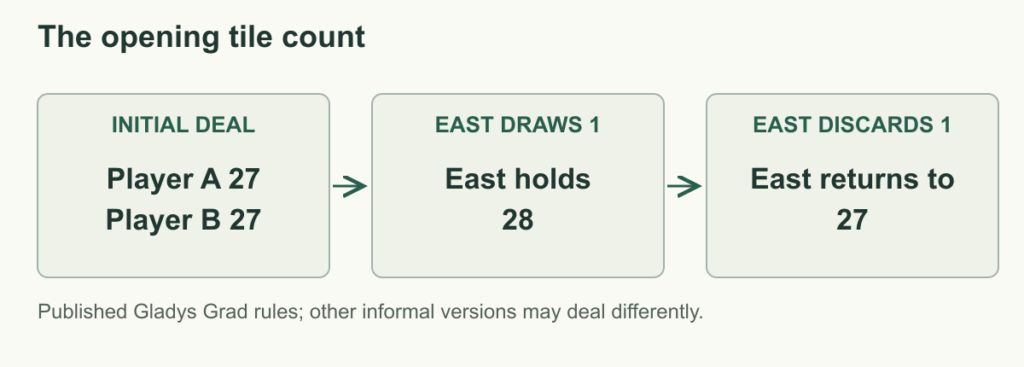
According to the published Gladys Grad rules, each player builds two walls, each 19 stacks long and two tiles high. Four walls of 38 tiles account for the 152-tile set. East breaks the designated wall according to the stated die procedure, and the players take the prescribed groups of tiles until both have 27 tiles. East then draws a 28th tile to open the game. If this sounds different from the “27 for one player, 28 for the other” shortcut you saw online, that is because it is a different dealing convention.
Step 3: Arrange tiles across the two racks
Look for two card patterns that your combined tiles might support. Under the published rules, tiles can be rearranged between your unexposed rack holdings during play, but exposed melds must remain associated with the correct hand. Do not physically combine the two racks into one oversized winning hand; you are trying to complete two separate valid 14-tile patterns.
Step 4: Skip the Charleston
The Charleston is a structured tile-passing phase familiar from the usual four-player American game. It does not occur in the published two-player Siamese format used here. You therefore move directly from preparing the initial holdings into draw-and-discard play.
Step 5: East draws and discards to start the round
East takes the opening 28th tile, evaluates both developing hands, and discards one tile under the published convention. The other player then draws from the wall or legally claims the previous discard and ends the turn with a discard as required. Both sides repeat the process, monitoring card patterns and the number of tiles held.
Step 6: Make legal claims and exposures
A legal claim may allow you to expose a qualifying group for the hand on the appropriate rack. The published rules set precise requirements for when a discard may be claimed, how to place the physical tile, and when an exposed hand becomes dead. A claim that is legal in one adaptation may not be handled identically in another. For early practice, read the relevant claiming section aloud before exposing anything uncertain.
Step 7: Complete one hand, then the second
In this format, one completed 14-tile mahjong is not automatically the end of the whole game. A player may declare and expose one valid hand, then continue pursuing the second. The rules specify how declared hands, available jokers, payouts, and dead hands are handled. A full double mahjong or exhaustion of the playable wall brings the round to an end, subject to the rulebook’s special cases.
A Simple Example of the Turn Sequence
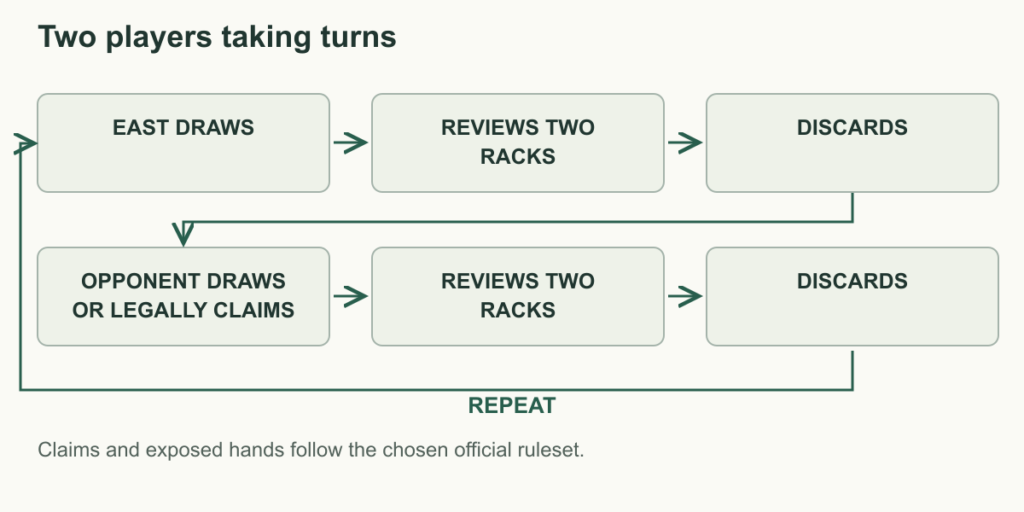
Imagine two players, Alex and Jordan. Each begins with 27 tiles spread across two racks. Alex is East and draws the 28th tile from the designated wall. Alex sees that it doesn’t help either planned hand, so the tile is announced and placed into the discard area. Jordan examines whether the discarded tile can be legally claimed for a qualifying exposure. If it cannot, Jordan draws the next tile from the wall, reviews both racks, and discards one.
This cycle continues. Halfway through, Alex finds a new card pattern that uses more of the available tiles and reorganizes the unexposed tiles between the racks. Jordan makes a legal exposure and places it on the ledge corresponding to the intended hand. Later, one 14-tile hand is completed and exposed; the second remains unfinished, so play continues under the variant’s rules.
The example demonstrates turn order and two-hand management only. It deliberately does not invent an official card combination or scoring result. Use the actual hand card and published rules to decide whether any claimed or exposed hand is legal.
Three Rules That Commonly Confuse Beginners
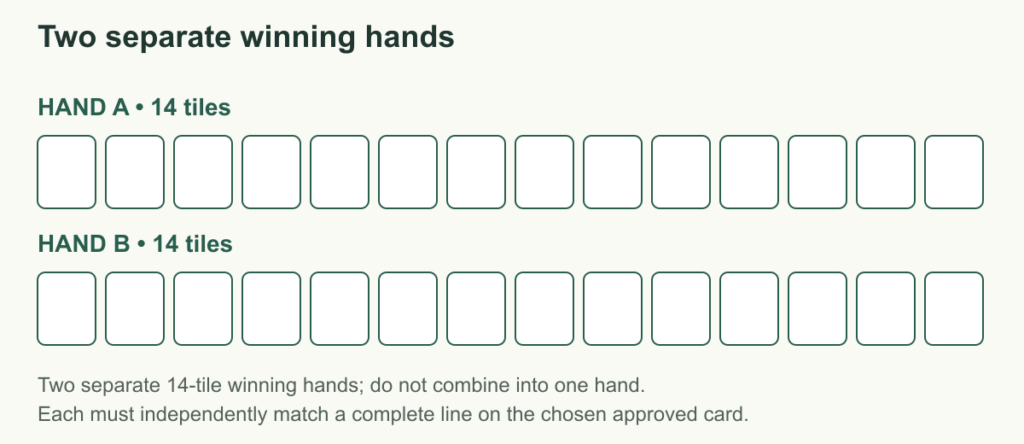
Two racks do not mean two unrelated games. The variant permits strategic movement of unexposed tiles between the rack holdings. This flexibility is part of the challenge, but each exposed hand must ultimately correspond to a valid 14-tile card pattern.
The first mahjong may not finish the game. Under the published format, players can continue working toward a second mahjong, and there are specific procedures for a hand that becomes dead. The exact declaration and scoring details are more nuanced than “first hand wins.”
Your source changes your setup. Some instructional videos teach a relaxed no-walls method. That may be perfectly enjoyable socially, but it is not the same setup as the published tournament rules. If the players disagree about walls or tile counts, settle the question before anyone starts drawing.
An Easy Practice Session for Your First Evening
The first goal should be learning the movement of tiles, not calculating payouts. Spend five minutes identifying suits and reading the card. Spend another ten minutes laying out the four racks and constructing the walls. Walk through the deal slowly while checking the printed official instructions. Then play a short demonstration round with both players explaining which hand each discard supports.
If you make a mistake, reset the exercise rather than inventing a rule to repair it. Try an intentionally open practice round where you can see each other’s planned hand; only switch to concealed play after you understand the sequence. As confidence grows, add proper calling, joker exchanges, and full scoring.
A useful way to divide learning is to assign one person the job of monitoring turns and tile count while the other keeps the official rules page open. Switch those roles for the next practice game. This lowers the mental load and makes both people familiar with the details.
How Two-Player American Mahjong Differs From Four-Player Play
Standard four-player American mahjong gives each participant one hand and usually uses a Charleston. The two-player variation asks each person to coordinate two hands while skipping that passing phase. This adds strategy and also creates new bookkeeping demands: rack placement, hand exposure, and tile count become especially important.
It can be a convenient format for practicing with a friend when a complete table isn’t available, but it is not a one-for-one replacement for learning ordinary American gameplay. If you intend to join a four-player club, you should still learn that group’s standard dealing, passing, and claiming procedures separately.
Frequently Asked Questions
Can you play mahjong with only two people?
Yes. Several two-player formats exist. For American-style play, a commonly used adaptation assigns two racks to each person and requires two valid winning hands.
Do two-player mahjong games use the Charleston?
The published Gladys Grad Siamese Mah Jongg rules do not use the Charleston. Verify that your chosen adaptation follows the same convention before beginning.
How many tiles does each player get in two-player mahjong?
Under the published rules used here, both players are initially dealt 27 tiles and East draws a 28th to start. Some casual tutorials describe a different opening count; those should be treated as separate house rules.
Can we play without building walls?
Some informal versions use a face-down tile pool. The published Gladys Grad rules describe walls and require them for tournament play, so players should agree on the exact format rather than mixing instructions.
Do I need a special mahjong set?
An appropriate American set, four racks or two double racks, and an agreed card are the key items. Check the tile count and card requirements for your chosen variation.
Conclusion
Learning how to play mahjong with 2 players becomes much easier once you choose one named version and stick with its rules. Set up two racks per person, learn the tile flow, and remember that you’re managing two real winning hands—not simply playing a shortened four-player game. Start with a friendly demonstration, keep the rules handy, and let speed come later.