


American Mahjong vs Chinese Mahjong: Rules, Tiles, and Key Differences
Learn why American and Chinese mahjong differ in winning conditions, jokers, scoring, tile sets, and pregame passing, with a clear comparison table.

The two games look familiar at first glance, but the winning hands, jokers, passing rules, and equipment can be surprisingly different.
Quick Answer: American Mahjong vs Chinese Mahjong comes down mainly to how you win. Standard American mahjong uses an annual National Mah Jongg League card, jokers, and a pregame tile-passing sequence called the Charleston. Many traditional Chinese variants build hands from sets and a pair, generally without an annual card or American-style jokers. Because Chinese mahjong includes several regional rulesets, exact tile counts, scoring, and special hands vary.
ON THIS PAGE
Introduction • American Mahjong vs Chinese Mahjong at a Glance
The Biggest Difference Is the Winning Hand • Tiles, Jokers, and Flowers: What Is Actually in the Box?
The Charleston: A Distinctive American Opening • Runs, Matching Sets, and Hand Planning
Scoring and Declaring Mahjong • Which Version Should You Learn First?
Frequently Asked Questions • Conclusion
Introduction
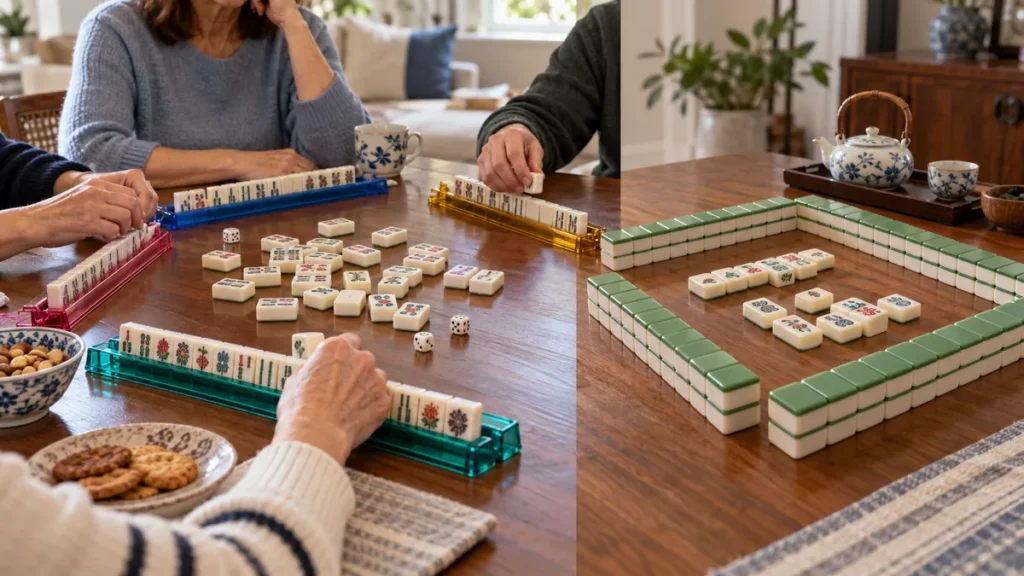
You sit down at a table with neatly arranged bamboo, dot, and character tiles. Everyone knows it’s mahjong—until someone passes three tiles across the table, mentions a yearly card, and asks whether your set has jokers. Suddenly, two people who have played for years may be talking about quite different games.
That confusion is common when comparing American mahjong vs Chinese mahjong. They share a family history, many recognizable tiles, and the rhythm of drawing and discarding. Yet the rules deciding a winning hand, the role of wild tiles, and even the opening minutes of play can change dramatically. This guide explains the practical differences without pretending every Chinese mahjong tradition is identical.
American Mahjong vs Chinese Mahjong at a Glance
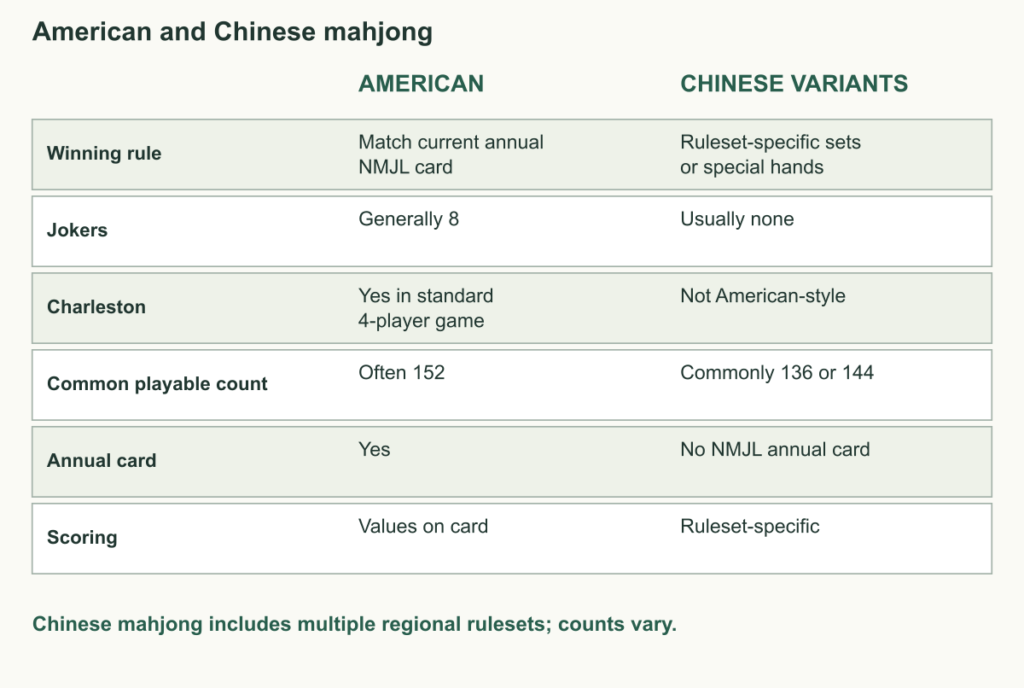
| Feature | American mahjong (standard NMJL-style) | Chinese mahjong (common traditional formats) |
|---|---|---|
| Main winning condition | Match one complete line of the current annual card | Usually complete allowed sets and a pair, or a recognized special hand |
| Jokers | Typically eight, with placement restrictions | Usually not used in traditional regional play |
| Pregame passing | Charleston is a characteristic feature | No American-style Charleston |
| Typical playable tile set | Commonly 152 including eight jokers | Often 136 basic tiles or 144 including bonus tiles |
| Card | A new NMJL card is used each year | No equivalent annual NMJL card |
| Exposed sequences | Card patterns don’t use chow runs as Chinese games do | Chows are used in many variants |
| Scoring | Based on the card and group conventions | Ruleset-specific points, fan/faan, or other scoring |
| Usual table | Four players, often with racks and pushers | Four players, racks optional depending on setting |
These are typical differences, not specifications for every set sold or every household. Packaged tile counts can include spares, blank tiles, or accessories. Always check the playable composition and the version your group uses before buying equipment.
The Biggest Difference Is the Winning Hand
In American mahjong, the current annual National Mah Jongg League card determines which complete 14-tile hands are legal. Each line specifies the required numbers, suit relationships, groupings, and sometimes whether the hand must remain concealed. A hand that resembles an earlier year’s line or a traditional Chinese combination is not automatically valid. The official card is the authority for NMJL-style play.
In many Chinese-style variants, the classic beginner structure is four sets and a pair. A set may be three matching tiles or a run of three consecutive numbers within one suit. Kongs and special winning hands have their own procedures, while some variations require a minimum scoring value before a hand can be declared. This is why the phrase “any four sets and a pair wins” is a useful introduction, but an oversimplification for actual competitive play.
Imagine a rack with two three-tile sequences, two three-of-a-kind groups, and a matching pair. You would recognize the basic Chinese-style shape. The same arrangement would not establish an American win unless it precisely matched a current card line—which it generally would not simply by coincidence.
Tiles, Jokers, and Flowers: What Is Actually in the Box?
The familiar numbered suits are Dots (circles), Bams (bamboo), and Craks (characters). Both game families also recognize winds and dragons. Those shared tile faces make the two games look similar, even when their interpretation differs.
A typical American playable set has 152 tiles: 108 suited number tiles, 16 winds, 12 dragons, eight flowers, and eight jokers. American tiles may also include Western numerals or English labels to help players read them. Many commercial packages add spare tiles, which makes the number on the box a poor substitute for checking what the game actually uses.
A common Chinese set has 136 basic suited and honor tiles, with an additional eight flower or season bonus tiles in many 144-tile sets. Some groups set bonus tiles aside. Other regional rules change how these tiles are used. Chinese-style sets typically do not need the eight American jokers.
Why the joker changes strategy
In standard NMJL-style American mahjong, jokers can stand in for permitted tiles in qualifying groups of three or more identical tiles. But jokers cannot represent singles or pairs. That restriction matters every time you examine a card line that includes a pair or singles-and-pairs pattern.
Traditional Chinese play doesn’t usually use the American joker system, so you rely on the actual tile combinations and whatever special rules your variant allows. That doesn’t necessarily make one version harder; it shifts which problems you solve during the game.
The Charleston: A Distinctive American Opening
The Charleston is a structured tile-passing phase that occurs before ordinary drawing and discarding in standard four-player American mahjong. Players use the passes to improve possible card patterns and release unwanted tiles. Its detailed sequence and optional elements belong to the group’s current rules.
Traditional Chinese formats do not use this American-style Charleston. Instead, players set up their walls and begin play according to their own deal and dealer rules. If you learned mahjong at a Chinese-family table, the American passing ritual may initially feel more foreign than the tile names.
It’s also important not to transfer the four-player Charleston to every two-player American adaptation. Some named two-player formats omit it altogether. Match the setup to your game, not to whichever instructional video happens to appear first online.
Runs, Matching Sets, and Hand Planning
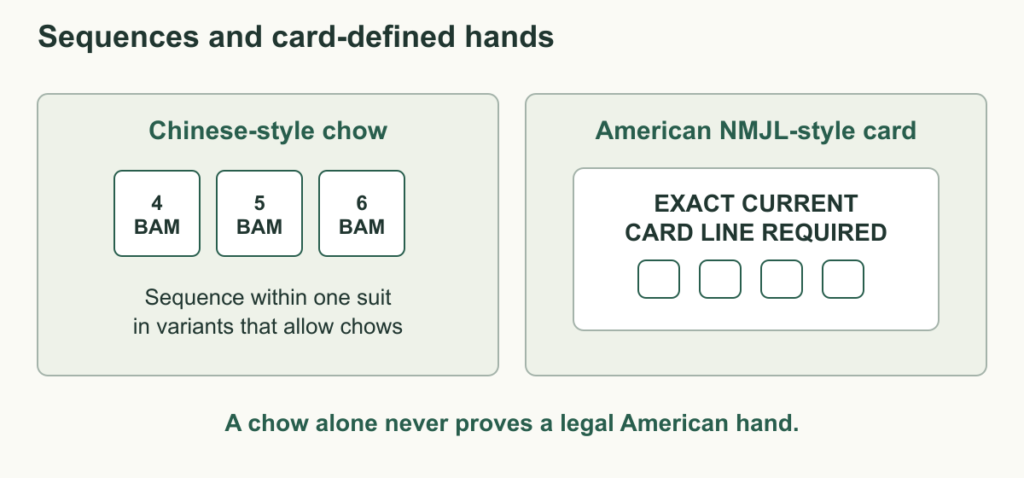
A chow is a run of three consecutive numbers within one suit—for example, 4-5-6 Bams. Chows are important in many Chinese variants, alongside pungs and kongs. A traditional-looking hand can combine runs, identical-tile groups, and a pair, as long as it meets the actual rules and scoring criteria.
American card patterns are different. A card may print numbers that look sequential, but those numerals express exact required tile groupings rather than granting permission to declare an ordinary Chinese chow. A string of 4, 5, and 6 tiles is useful only when the entire line and group-size requirements are satisfied. This distinction is a major reason the two games need separate beginner guides.
If you’re new, lay out tiles to demonstrate a pair, a pung, and a chow. Then choose your version and ask whether each group can play a role in the corresponding winning pattern. Seeing the structures side by side teaches more than memorizing long terminology lists.
Scoring and Declaring Mahjong
American NMJL-style hands have printed values on the annual card, with table rules determining how scores and payments are handled. Exposures, joker exchanges, and whether a hand is concealed also affect legal play. A valid declaration must satisfy the card line and any applicable rules, not merely look organized.
Chinese mahjong scoring differs from one region to another. Some tables use fan or faan concepts and require a minimum threshold; others use distinct systems. Recognized special patterns can change the score dramatically. So there is no reliable single “Chinese mahjong scoring chart” that covers every family game, social club, and tournament.
The most helpful question to ask a host is not “How do you score Chinese mahjong?” but “Are we playing Hong Kong, Chinese Official, or another version—and can I see that version’s score guide?”
Which Version Should You Learn First?
The practical answer is whichever version the people around you actually play. If your neighborhood group uses NMJL cards, start with American mahjong so your learning transfers directly into their games. If your relatives use a particular Chinese regional ruleset, learn that instead. Tile recognition will help you cross over later, but assume the winning hands and scoring need fresh study.
For American mahjong, learn tile families, the current card, group sizes, joker restrictions, and the Charleston. For Chinese-style mahjong, learn the chosen ruleset’s sets, basic hand shape, calls, scoring minimum, and any special hands. Watch one game, handle the tiles, and ask players to explain one decision per turn rather than attempting every rule at once.
Can you use the same set for both?
Sometimes, with limitations. A complete American set usually contains the suits and honors needed for many Chinese games, so players may set aside jokers and other unused tiles. A basic Chinese set may lack the American jokers, matching flowers, or rack accessories expected at an NMJL-style table. Before purchasing, ask the club which set configuration it uses and inspect the product’s actual tile inventory.
Frequently Asked Questions
Is American mahjong easier than Chinese mahjong?
Neither is universally easier. American play asks you to read an annually changing card and learn joker and passing rules. Chinese variants often require more attention to permitted patterns and their scoring. Familiarity with your group’s version usually matters more than the label.
Do both versions use 144 tiles?
No. Standard American NMJL-style play commonly uses 152 tiles including eight jokers, while many Chinese sets have 136 basic tiles plus eight bonus tiles. Retail boxes can contain extra spares, so advertised package totals vary.
Does Chinese mahjong use jokers or the Charleston?
Traditional Chinese regional formats generally don’t use American-style jokers or the Charleston. Some nonstandard or modern variants may differ, so identify the actual ruleset.
Does the American mahjong card change every year?
Yes, the NMJL publishes an annual card containing that edition’s legal winning hands. Use the card for the year your table is playing.
Can a Chinese mahjong player join an American table immediately?
Knowing the tiles provides a head start, but the player still needs to learn the American card, passing phase, joker rules, and declaration rules. A beginner session is the easiest transition.
Conclusion
American Mahjong vs Chinese Mahjong is less about one set of tiles being right and the other being wrong than about the rules people agree to play. American mahjong centers on the annual card, jokers, and the Charleston; Chinese mahjong encompasses multiple traditions with their own hand structures and scoring. Choose your table’s version first, then learn its winning condition. That’s the simplest path from recognizing tiles to enjoying an actual game.