


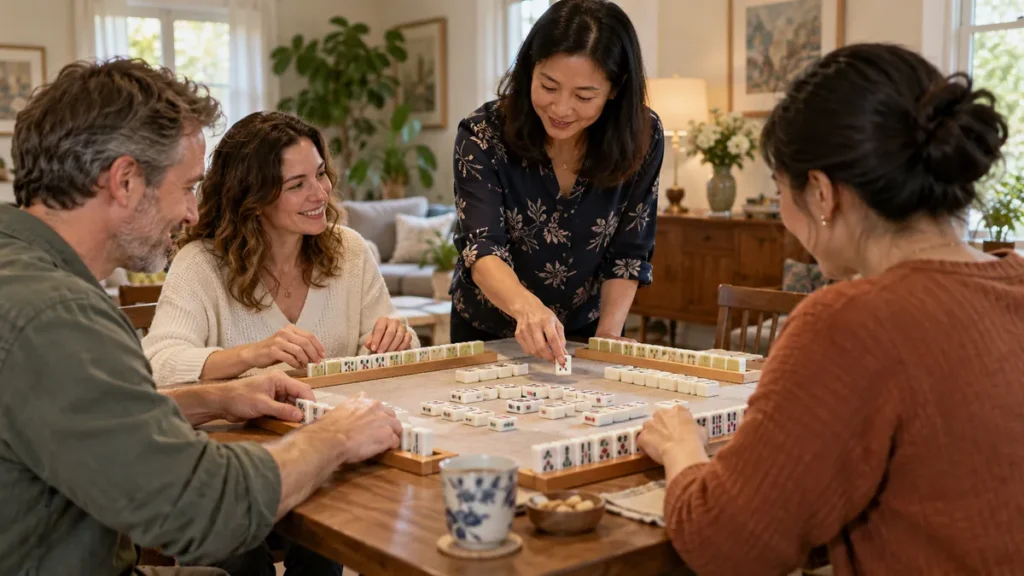
Mahjong looks complicated when every tile is unfamiliar. This friendly learning plan makes the first game less intimidating by showing you what to study first, what to ignore for now, and how to practice without memorizing an entire rulebook.
Introduction
A table full of brightly patterned tiles can feel like a secret language. Experienced players call out discards, rearrange racks, and recognize combinations that look almost identical to a newcomer. The good news is that you do not have to understand everything before enjoying your first lesson. You need a specific version of the game, a basic grasp of the tiles, and someone—or a reliable tutorial—to walk through the rhythm of a turn.
There isn’t one universal set of mahjong rules. American mahjong, Chinese classical-style games, Hong Kong-style play, Japanese riichi, and other variants share ancestry but differ in scoring, winning hands, and sometimes equipment. In the United States, a beginner invited to an “American mahj” table will often encounter the National Mah Jongg League (NMJL) style and its annually issued card. That is the primary version covered here.
Quick Answer: The best way to learn mahjong is to choose one ruleset, identify its tiles, understand the objective, watch one complete sample round, and practice with patient players. For American mahjong, begin with the numbered suits, winds, dragons, flowers, jokers, and current year’s approved hand card. Learn drawing and discarding before attempting advanced strategy.
ON THIS PAGE
Introduction • Choose Your Mahjong Version Before You Start
Learn the Tiles in Fifteen Minutes • Understand What It Takes to Win in American Mahjong
Follow the Flow of One Round • The Best Seven-Day Practice Plan for Beginners
Five Mahjong Mistakes to Avoid at the Start • Where to Learn Mahjong Without Spending Much
Frequently Asked Questions • Conclusion
Choose Your Mahjong Version Before You Start
Ask the person teaching you, “Which version are we playing?” It is the fastest way to prevent confusion. In American mahjong, players use a card that changes annually and specifies valid winning combinations. In other variants, familiar patterns such as sequences of three tiles may be central to play. Rules from one system cannot safely be pasted into another.
| If your group plays… | Start by learning… | A common beginner trap |
|---|---|---|
| American mahjong | Annual hand card, suits, Charleston, jokers | Treating sequences as automatically valid |
| Hong Kong-style mahjong | Melds, chow/pung/kong concepts, local scoring | Assuming American-card hands apply |
| Japanese riichi | Furiten, yaku, riichi and scoring basics | Learning advanced scoring before turn order |
The simplest first move is to find an in-person beginner class or a tutorial that names its variant clearly. Avoid switching between three versions during your first week. Their shared terminology can make differences harder—not easier—to notice.
Learn the Tiles in Fifteen Minutes
For American mahjong, a standard set used for play contains 152 tiles. Numbered tiles appear in three suits: dots, bams (bamboo), and craks (characters), each numbered one through nine, with four copies of each. There are also wind tiles (east, south, west, north), red, green, and white dragons, flowers, and jokers.

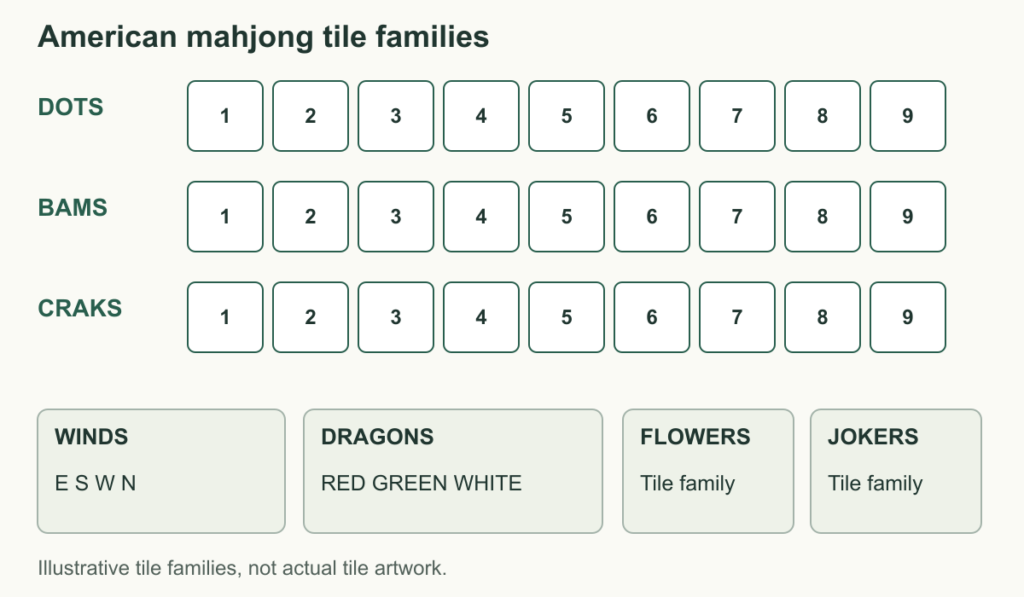
Practice sorting the tiles into families before attempting a round. Create one line of dots 1–9, another of bams 1–9, and a third of craks 1–9. Then separate the winds, dragons, flowers, and jokers. Tile art varies by manufacturer, so focus on what the symbol represents rather than memorizing a particular design.
You can practice with photographs if a physical set is not available. However, when buying a set for an American game, verify the number of tiles and whether it includes the jokers and flowers your group expects. A set marketed simply as “mahjong” may be intended for another variant.
A tiny tile-reading exercise
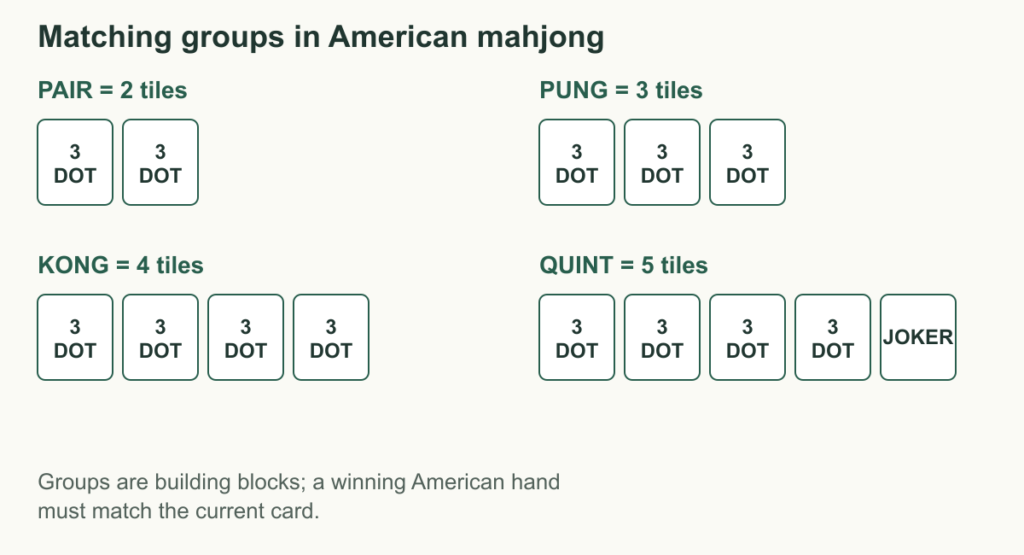
Put down a 3-dot, a 3-bam, and a 3-crak. They share the same number but belong to different suits. Next, place three identical 3-dot tiles together: that is a pung, a matching group of three. Add a fourth identical 3-dot and the group becomes a kong. This vocabulary becomes important when reading an American card.
Understand What It Takes to Win in American Mahjong
In standard four-player American mahjong, a player wins by assembling a 14-tile hand that exactly matches one of the patterns on the currently used hand card. The card defines which combinations are valid and what they are worth. A beginner should keep the card visible and use a line marker to follow one promising row rather than trying to memorize the entire sheet.
You may see pairs (two identical tiles), pungs (three), kongs (four), and quints (five, usually involving a joker). Unlike many Chinese-style variants, a run such as 2-3-4 is not automatically a valid American meld; each tile must occupy the exact role specified by the chosen card pattern. Jokers generally substitute within qualifying groups of three or more, not in a single or a pair. Check the rules adopted by your group and its card.

Cards are issued annually, so a pattern copied from a random blog post may not exist on the current card. Use an authorized current card to learn the real game. Do not rely on AI-generated reproductions of official card hands, which can be both inaccurate and copyrighted.
Follow the Flow of One Round
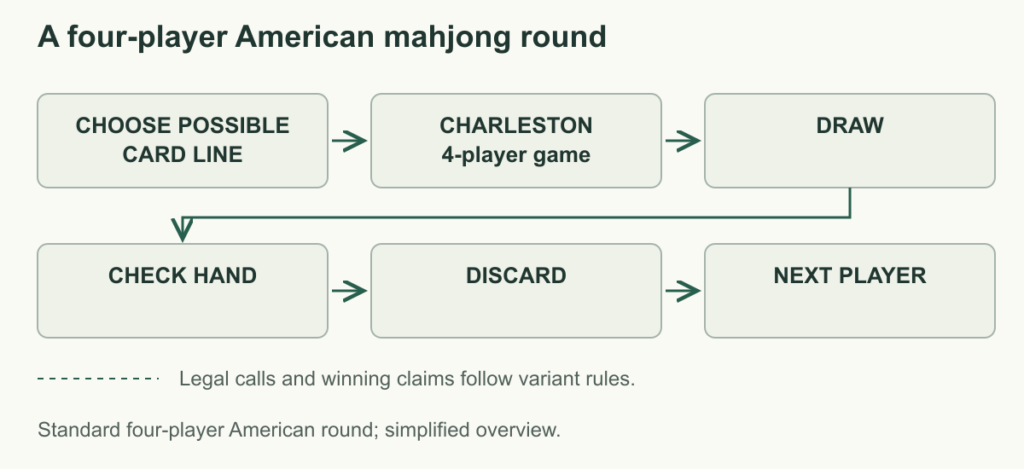
Once players have prepared the tiles and built walls, the dealer and group establish the deal under the rules they follow. You do not need to master every setup detail at once; ask to watch the first deal. Your immediate learning goals are the tile exchange, drawing and discarding, and understanding when someone may claim a discarded tile.
Step 1: Look at your tiles and the card. Identify a handful of card patterns that could plausibly fit. Avoid committing to a single ambitious hand after only a few seconds.
Step 2: Complete the Charleston when your game uses it. In the standard American game, players exchange tiles in a structured passing phase called the Charleston, with specific directions and optional stages. A teacher should demonstrate the pass order physically; do not improvise your own.
Step 3: Take a turn. On ordinary turns, a player draws a tile, assesses whether it helps a possible hand, then discards one tile. Announce the discard clearly so the other players can respond under the rules.
Step 4: Learn when tiles may be called. Under American rules, another player’s discard may sometimes be claimed to complete an allowable exposed combination or a winning hand. A pair or single has different restrictions from a pung or kong. For your first game, ask your teacher to pause before each call and explain why it is legal.
Step 5: Check every completed hand against the card. Fourteen tiles that look attractive are not enough. The precise pattern, color convention, and joker restrictions must match a valid line.

The Best Seven-Day Practice Plan for Beginners
Day one: Spend 15 minutes sorting tiles and naming the three suits. Day two: Identify winds, dragons, flowers, and jokers. Day three: Read five sample card notations with a teacher without trying to play. Day four: Observe a full game or reputable instructional video, tracking only draws and discards. Day five: Play an open-hand practice round where everyone can explain their decisions. Day six: Replay two moments when a discard was called. Day seven: Attend a friendly beginner game and aim to finish the session understanding the turn order—not necessarily winning.
This approach gives a different goal to each session. It prevents an overwhelming first evening where you try to learn tile symbols, scoring, etiquette, and strategy simultaneously. If you learn better socially, invite a friend into the same beginner class; having another person asking basic questions can make the experience feel less intimidating.
Five Mahjong Mistakes to Avoid at the Start
Mixing different rulebooks. A Chinese-style tutorial may be perfectly accurate but wrong for your American game. Label your notes with the variant every time.
Studying advanced strategy too early. Learn what a turn looks like and how legal hands are defined before thinking about defensive discards or probability.
Buying the wrong set. Check the contents and ask your group for a recommendation before investing in equipment or a decorative travel set.
Trying to memorize every hand. Use the card. Good early play is about comparing possibilities and noticing what your tiles support, not extraordinary memory.
Feeling embarrassed about questions. Beginner sessions are designed for pauses. Ask players to identify discarded tiles aloud and explain calls; that single change can speed up learning considerably.
Where to Learn Mahjong Without Spending Much
Look for beginner instruction at community centers, public libraries, recreation departments, senior centers, local game shops, and dedicated mahjong groups. Some teach American rules, while others use a Chinese or Japanese variation. Before attending, confirm the version, whether you should bring a card, whether equipment is supplied, and whether absolute beginners are welcome.
Online resources can complement lessons. I Love Mahj’s beginner guide walks through American tiles and card reading. Mahjong 4 Friends explains the standard game’s objective, equipment, and turn sequence. Use named specialist resources instead of anonymous screenshots of questionable rule sheets.
If your goal is to play with just one friend, remember that two-player adaptations have their own rules. Learn ordinary American tile vocabulary first, then explore those separate formats rather than treating a four-player game as interchangeable with a two-player game.
Frequently Asked Questions
Is mahjong hard to learn?
The vocabulary can be unfamiliar, but the first steps are manageable when taught in sequence. Recognizing tiles and understanding a turn are simpler goals than memorizing an entire card or scoring system.
What is the best way to learn mahjong at home?
Use a variant-specific beginner guide, sort real or photographed tiles, then watch one fully explained round. If possible, join a live beginner practice game so you can ask about calls and discards.
Do I need to memorize the American mahjong card?
No. The approved annual card is a reference players use during games. Learn how its patterns are represented rather than attempting to memorize every combination.
Can I play mahjong with two people?
Yes, but you need to agree on a two-player variant. Popular American adaptations typically give both players responsibility for more than one hand, and rules differ by version.
Conclusion
The best way to learn mahjong is to make the first few sessions smaller than the whole game. Choose a version, recognize the tiles, follow the flow of play, and ask questions at a beginner-friendly table. Strategy becomes enjoyable once the basics stop demanding all your attention. Before long, those once-mysterious tiles begin to look like possibilities rather than puzzles.